How Invisalign Helps Maintain Better Oral Hygiene Than Traditional Braces
Many people choose to use either Invisalign® or traditional braces to correct their smiles for health-related reasons as well as aesthetic ones. In addition to not creating a straight smile, crooked teeth can make brushing and flossing between them difficult, which can lead to cavities, gum disease and health problems down the road. Surprisingly, the method chosen for straightening teeth can also have a big impact on tooth health as well as appearance, so it is important to choose wisely.
Oral hygiene with traditional braces
With traditional braces that are composed of wires, bands and fixed brackets, there are many spaces on and around the teeth where food and bacteria can get trapped. These particles can be difficult to remove even with careful brushing, and wearers must be sure to target every surface of their teeth and braces to prevent long-term buildup and decay around the metal attachments.
Because brackets are secured to every tooth for the duration of treatment, people with braces need to be especially diligent when brushing teeth to prevent tartar buildup over the months and years of treatment. If wearers are not careful, teeth can become discolored, causing a difference in color between the location under the brackets and the rest of the teeth. Letting plaque collect in hard-to-reach places can also lead to the formation of cavities that are harder to treat with braces in the mouth.
Like brushing, flossing also becomes trickier with traditional braces. People often must use a special threading tool to move floss behind the wires or use a water flosser to clean between teeth. The increased difficulty in flossing and brushing can lead to poor hygiene habits, and braces wearers may experience increased gum issues, such as inflamed and bleeding gums, as a result.
Oral hygiene with Invisalign®
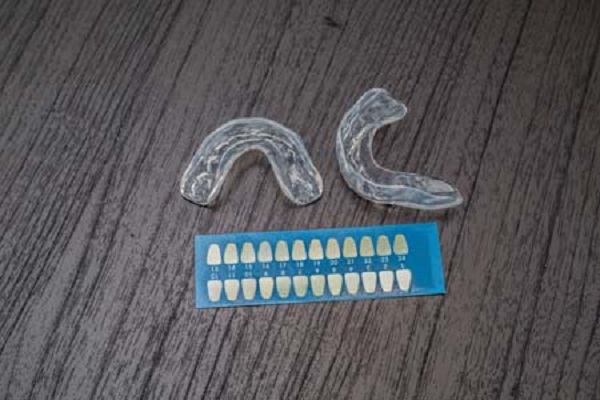
Because the Invisalign® system is composed of removable trays, most of the concerns stemming from traditional braces do not exist. Since the clear aligners can be removed at any time, wearers can take them out while eating, drinking and brushing teeth. Therefore, there are no new spaces in the mouth for food to get trapped or the need for any brushing or flossing adjustments caused by the aligners.
Although the aligners are removable for all patients, some wearers do need to have smooth attachments or buttons affixed to hard-to-move teeth to help the trays work. However, because these attachments are small, clear, smooth bumps rather than metal brackets connected to bands and wires, cleaning around them is simpler and does not require extra tools. Furthermore, the attachments or buttons are generally only placed on a few teeth, as compared to traditional brackets that are attached to every tooth and connected with a wire, which minimizes chances for discoloration as compared to traditional braces.
Conclusion
With standard braces, patients may need to significantly change their oral hygiene habits or use additional tools to prevent tooth and gum issues. While wearing Invisalign®, an oral hygiene routine can remain largely unchanged as long as a patient is already practicing good habits.
Are you considering Invisalign® in the Huntsville area? Get more information at https://www.yourhuntsvilledentist.com.
Check out what others are saying about our services on Yelp: Read our Yelp reviews.
Recent Posts
Even though a kids dentist can help children build healthy habits through regular dental checkups, much of their daily oral care happens at home. Parents play an important role in teaching proper brushing, encouraging consistency, and making dental hygiene feel like a normal part of the day. Small routines can help children protect their teeth…
Dentures can restore a complete smile and make everyday eating and speaking easier, but they still need regular professional attention. Changes in fit, comfort, or appearance may signal that an adjustment or repair is necessary. A general dentist can evaluate the problem and help protect the gums, jaw, and remaining teeth.Dentures experience daily pressure from…
Teeth whitening has become one of the most popular cosmetic dental treatments, and many patients choose at-home options because they offer convenience without sacrificing professional oversight. Unlike over-the-counter products, professionally provided whitening systems combine customized treatment with predictable results. A dentist often recommends the right whitening approach based on each patient's goals, oral health, and…
Dental implants can replace missing teeth, but some patients may need a tooth extraction before treatment begins. This depends on whether a damaged or unhealthy tooth remains in the area where the implant will go. Our general dentist can examine your tooth, gums, and jawbone to decide whether saving the tooth or removing it offers…